“I was the youngest, I loved to play outside, preoccupied with nature. I climbed trees, dug holes, collected rocks, sea shells, leaves and the like. I was sure to delight over even the most inconsequential element that came from my backyard. In fact, it was more natural for me to relate to the environment than to people. Landscape photography became an expression of this relationship. As an adult, I still always want to be outdoors, walking with a found stick, making up songs about the river, pretending to be a nomadic sheep herder.
I had a camera as far back as I can remember. Maybe not as early as the crib, but I definitely had a professional 35mm single lens reflex camera by the age of 10 thanks to my father who was himself obsessed with photography. He was also the parent who introduced the ‘you-must-suffer-for-the-highest-standard’ concept. Consequently, I must surpass every image I shoot, even before I finish downloading it, often staying up quite late and waking quite early. Maybe it’s my thyroid.
Through my school years, I found a sidekick who loved the outdoors as well. My best friend, Aileen, appeared in my every photograph but not as the subject matter. I could care less about portraiture. She performed brilliantly as a human clamp, her body forming a giant ‘x’ as she held a bed sheet for me as the backdrop for the giant Atlas moth that I needed to document along with several hundred other things I found in the yard. Aileen wasn’t a model but her hand always appeared in the scientific pictures I took of wasp nests that I made her hold to catch the natural light.
Although I always showed talent in the arts, my only role models were television’s Walt Disney, and Jon Gnagy, who not only taught viewers how to draw but taught them that art was glibly synonymous with cartooning with no meaningful function whatsoever. This was also the time of NASA’s Apollo space missions and, along with my peers, I was inspired. Aileen even named her cat ‘Splashdown.’ Loving science, I wanted to be an astronaut. Sadly, I did not love regents math, the gatekeeper of all desirable careers. I don’t think I’d be too happy with zero gravity inside a tiny capsule without daylight for weeks on end, either.
In my first photography class as a college freshman, one assignment involved taking pictures of people in New York City to boot. I was completely flabbergasted, unable to figure out what to do. My professor was locked in a prolonged silence as he deliberated over my picture. Searching for the gentlest choice of words, he uttered, “This isn’t even a good snapshot.”
Apparently, it had no ill effect, at least not that I know of. I kept taking pictures. Eventually, I was accepted to the photography department of an Ivy League graduate school. That meant that with a Masters degree in Fine Art Photography (which always has to be capitalized since I spent five very large figures on my education), I could no longer just take pictures for no good reason. I soon realized that my degree–and a buck–got me a cup of coffee. That was then. Now, coffee costs $2.50 but I still refuse to stop taking pictures.
In my last year of graduate school, I met non-English-speaking relatives who had just arrived in the States. After a period of grandiose gestures and vocal sounds and flamboyant huggings, we all stood smiling, looking at one another stupidly with nothing to say. A cousin stepped in to translate. I recall the puzzled looks and the irony of hearing, “And this is my uncle’s other daughter. She went to school for 6 years to learn how to take pictures.”
Whenever I traveled, I brought the camera and the act of taking photographs actually defined each journey. Twice the Police were called. Apparently, it is against the law for a New Yorker to walk down the street at dusk in central Texas and take flash photographs of nothing in particular. The same is true in rural Florida but you will be chased by a Police car as you flee on foot. I might have best examined how it could be determined that I was from New York.
During and just after graduate school, I made photographs with a 2-1/4” square format twin-lens reflex and 4×5” view cameras loaded with 50 ASA Fujichrome transparency film. There were no digital cameras. SONY had not yet invented the Mavica containing a drive which wrote to a mini CD. Does this expense and elaborate process of working demand that images are made with thorough deliberation? Heck, no. You can get free film samples at photo shows at the Jacob Javits Convention Center.
Somehow, in the course of 4 years of undergraduate and 2 more of graduate school, I had also gotten over a fear of the dark. Loading color film in 4×5” holders demanded total darkness as did developing black and white film. I began to love that environment for its sensory intensity and sacredness. Realizing what I was willing to overcome enabled me to see the high regard I held for photography as an art.
One cannot photograph nothing; every image, even of empty space or sky, will record, time, temperature and space itself, regardless if it is on our plane, or cosmic–as through a telescope, or subatomic–as through an electron microscope. Photography is the art of editing, framing, and selecting. It is the art of search. Unlike paint on a raw canvas, it does not add as much as it subtracts. Now with a digital palette of possibilities, photography is the art of creation and/or destruction of reality. Unlike painting, we actually intend to believe what we see in the photograph; unlike sculpture, photography is ethereal. Ideas and reality live in zero gravity. Photography is not limited by the forces of the universe. It is also the ideal medium to record the laws of the universe being broken. We have an innate ability to suspend disbelief. We also have an innate need to believe.
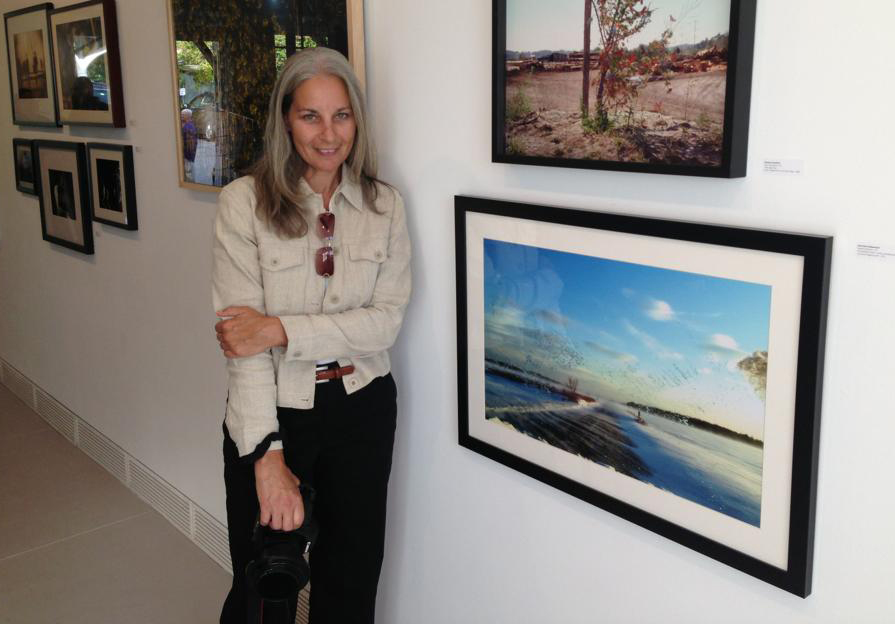
Miranda Gatewood is an East End, Long Island resident and was editor of Networking® magazine for 12 years.





 MIRANDA GATEWOOD